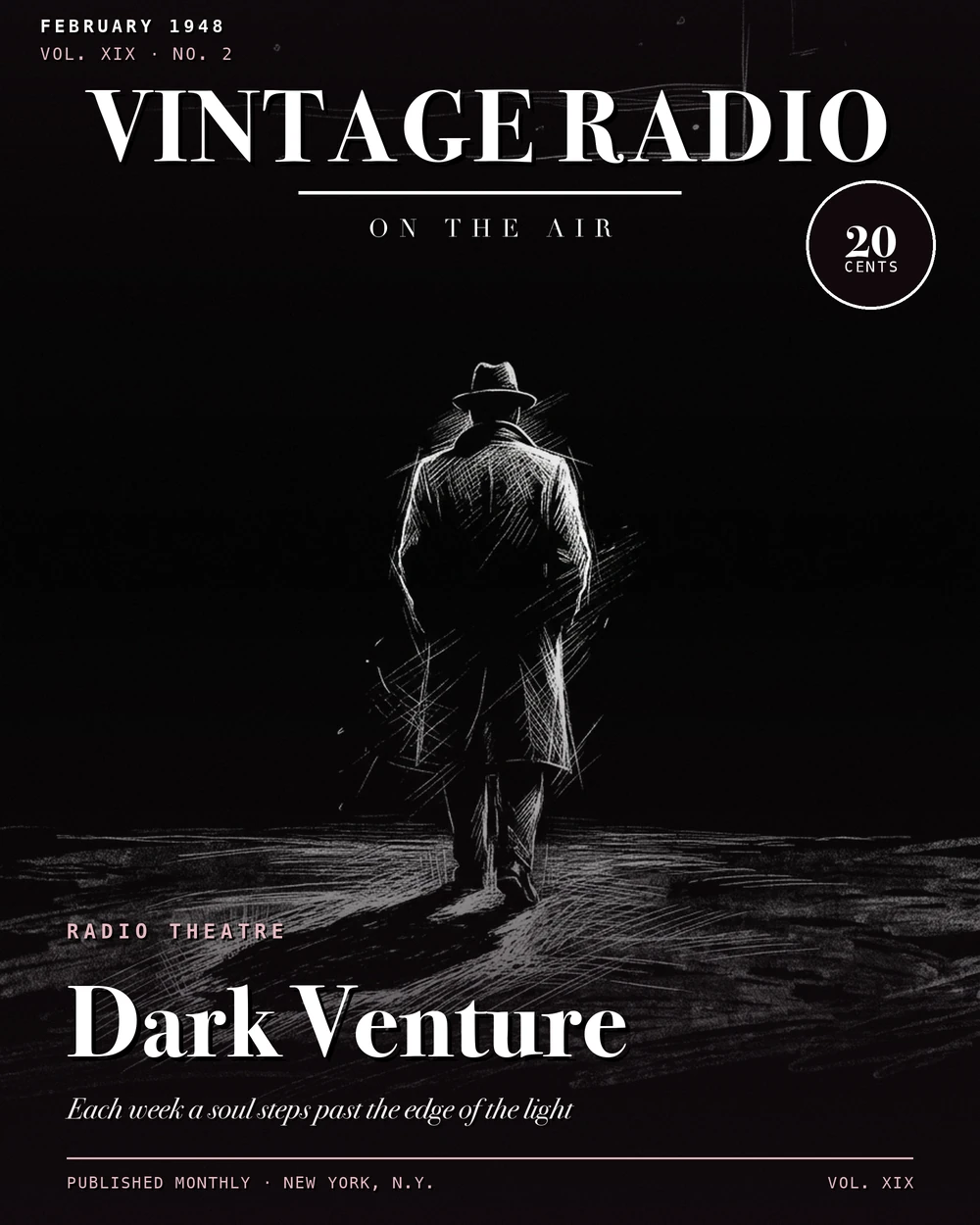
Dark Venture
The Idea Behind the Show
Dark Venture opened not with a murder already done, but with the moment just before it. The premise — put the listener inside the mind of someone crossing the line into crime — came directly from producer J. Donald Wilson's longstanding interest in psychology. Each episode followed a character from that threshold moment through the act itself and on to a reckoning, usually arriving at a twist ending that turned on some small detail the criminal had overlooked. The show wasn't supernatural. No ghosts, no monsters. The horror came from watching an ordinary person reason their way toward something terrible and almost convince themselves it was going to work.
That structure wasn't accidental, and it wasn't new to Wilson. He had built a similar framework years earlier when he created The Whistler for CBS Radio's West Coast division, which premiered May 16, 1942. When Wilson moved over to ABC and rose to production head of what had been NBC Blue, he and director Leonard Reeg developed Dark Venture along the same lines — the omniscient narrator, the psychological close-up, the criminal's interior monologue playing out in real time. The stylistic resemblance between the two shows was entirely deliberate.
The series premiered on May 30, 1945, initially as a West Coast regional broadcast on ABC's Pacific Coast network, which reached fifteen stations across five states. Production ran out of KECA, ABC's Hollywood affiliate, for the show's entire run. On February 19, 1946, it expanded to the full national ABC network, where it ran until February 10, 1947.
How It Sounded From the Inside
The most distinctive thing about Dark Venture's construction was where the narration came from. John Lake received the narrator credit, and he delivered the series' opening lines — "Over the minds of mortal men come many shadows… shadows of greed and hate, jealousy and fear" — but once the story was underway, the narration shifted into the criminal protagonist's own first-person voice. Listeners didn't watch the crime from a distance. They heard the planning, the justifications, the cold calculations, delivered as interior monologue by the very person committing them.
Writer Larry Marcus — full name Lawrence B. Marcus — was the primary architect of this approach, and his scripts were noted for exactly that quality: psychological depth and the kind of narration that made a character's reasoning feel uncomfortably plausible. In a piece he wrote for the New York Times on April 7, 1946, two months into the national run, Marcus described his approach as requiring believable characters and genuine emotional upheaval. His stories weren't about stock villains. They were about people whose logic, followed step by step, led somewhere awful.
After the show went national, two separate versions of each episode were produced every week. The eastern broadcast used orchestral music. The western broadcast used organ music provided by Dean Fossler. The western version was also cut by three minutes to accommodate commercial announcements the eastern broadcast didn't carry — a notable production wrinkle for a show that was, at its core, a mostly sustained regional operation trying to hold itself together on a national stage.
The People Who Made It
Wilson and Reeg are the two names at the center of Dark Venture's creation — Wilson producing and Reeg directing, with the show built around Wilson's psychological instincts and Reeg's execution. Wilson's career was substantial well beyond this series. Born in Kansas City, Missouri, on June 5, 1904, he had worked as a radio and film writer, producer, and voice actor, and had even voiced Mickey Mouse in select 1938 broadcasts of The Mickey Mouse Theater of the Air. By 1946 he was serving as ABC's West Coast program director, and by 1949 he had been promoted to vice president in charge of programs at ABC.
The cast was drawn from the working pool of West Coast radio talent, with a rotating anthology format that let the same performers take different roles across episodes. Among the women, Jeanne Bates, Betty Moran, and Lurene Tuttle were considered the top-tier performers. Tuttle, known in the industry as the "First Lady of Radio," was reportedly appearing in as many as fifteen radio shows per week during this period — Dark Venture was simply one of many concurrent commitments. Bates was simultaneously active in Hollywood horror and noir films for Columbia Pictures, including The Return of the Vampire (1943) and Shadows in the Night (1946). Radio newcomers Daphne Drake and Martha Shaw also appeared in female roles.
Male roles were regularly filled by character actors Charles Lung, Earl Ross, and Bill Johnstone, alongside Dwight Hauser in the rotating anthology mix. Stage and screen actors William Tracy and Carl Harbord made individual guest appearances. Howard McNear, later familiar to television audiences from The Andy Griffith Show, appeared in at least one episode — the August 7, 1945 broadcast of "Eclipse," which was co-written by Marcus and Robert Light. When previously aired 1946 episodes were adapted for the Armed Forces Radio Service's Mystery Playhouse without Wildroot's promotional copy, narrator duties went to Hunter Galloway rather than Lake.
Sponsorship and Reception
The show ran mostly without a sponsor. Wildroot, acting through its longtime advertising agency Batten, Barton, Durstine & Osborn, signed on April 16, 1946, to promote Wildroot Cream-Oil Hair Tonic, and that arrangement continued through April 8, 1947. Harry Walstrom served as commercial spokesman during the sponsored period. Outside those brackets, the show was sustained.
Critical reception, when it came, was positive. Radio Life magazine praised the series on January 27, 1946, during the final weeks of the West Coast run, calling it "realistic psychological studies of men and women with troubled minds." After the national expansion, Mike Mann of the Knickerbocker News in Albany called it "one of radio's standout dramas…a psychological thriller with plenty of action." Walter Winchell, who reached an enormous readership through his syndicated column, weighed in on April 14, 1946, calling Dark Venture "gifted with fine word weaving–a rarity among radio dramas." That was meaningful exposure for a show that had been a regional operation just weeks earlier.
What Survived, and What Came After
Estimates of the show's total episode count vary. The national network period alone — February 1946 through February 1947 — accounts for roughly 52 episodes. Radio historian Karl Schadow, writing liner notes for the Radio Spirits CD collection, put the full 1945–1947 run at approximately 130 episodes. Of those, only about a dozen are known to survive, and the copies that exist are largely the AFRS rebroadcast versions with the Wildroot copy stripped out.
Surviving titles include "Pursuit" (July 31, 1945), "Eclipse" (August 7, 1945), "A Simple Case of Murder" (July 2, 1946), "The Chase" (August 3, 1946), "The Only Inhabitant" (November 18, 1946), "The Man in 206" (December 2, 1946), "The Miser" (December 9, 1946), "Cover-Up" (February 25, 1947), and "The Boarder," among others.
The show's afterlife was modest but real. Bell International attempted a television adaptation in 1949, though it didn't produce a continuing series. More concretely, Larry Marcus parlayed his Dark Venture story work into a film career. His radio material supplied the basis for the 1951 film Cause for Alarm!, for which he received story credit. He also wrote the screenplays for Backfire (1950) and Dark City (1950), and later became the primary writer on the television anthology series One Step Beyond (1959–1961). The psychological crime-drama framework he refined on Dark Venture — plausible characters, interior narration, the slow unraveling of a scheme — translated well into other formats, which is perhaps the clearest measure of how seriously the show's writers took the work.